
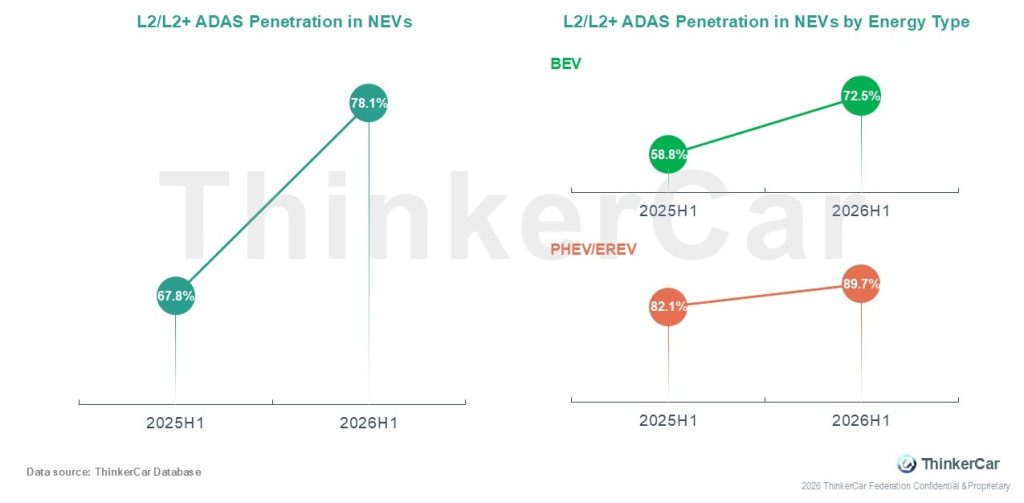
From 2025H1 to 2026H1, the overall L2/L2+ ADAS penetration of China’s NEVs increased from 67.8% to 78.1%.By energy type, PHEV/EREV models sustained higher ADAS penetration than BEVs, rising from 82.1% to 89.7%, compared with BEVs’ growth from 58.8% to 72.5%
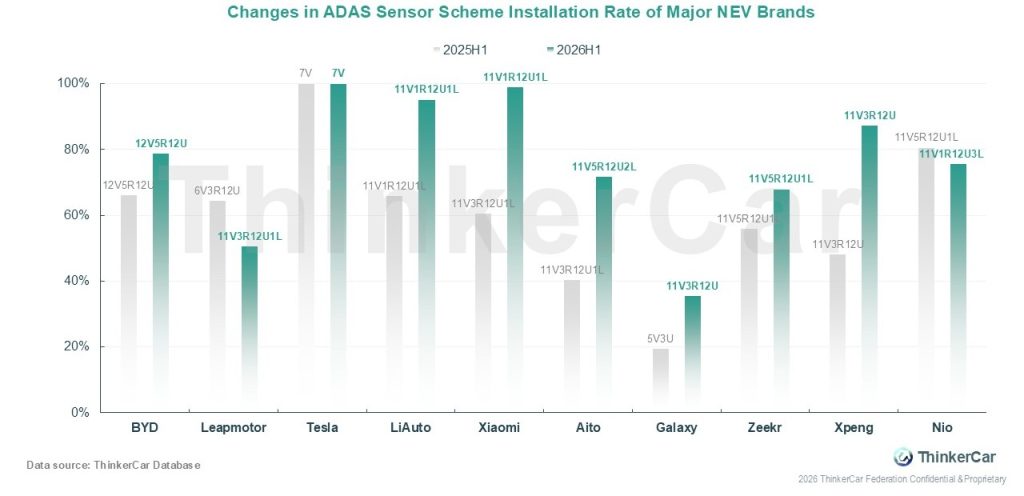
Comparing data between 2025H1 and 2026H1, major NEV OEMs show obvious differentiation in ADAS hardware strategies. BYD, the leading player, mainly adopts the 12V5R12U scheme; Tesla maintains full deployment of the 7V vision-only solution; Xpeng prioritizes the lidar-free 11V3R12U scheme; Li Auto, Xiaomi, Zeekr and Nio promote lidar-equipped multi-sensor fusion solutions. Overall, the installation share of high-level perception schemes with lidar keeps rising. Meanwhile, some automakers continue to iterate vision-only and low-radar architectures, forming an industry landscape with multiple parallel technical routes
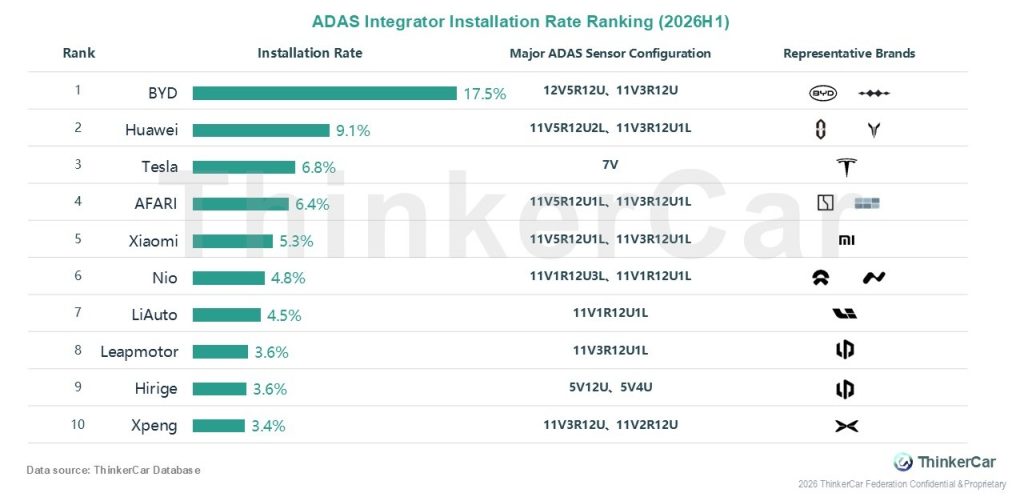
The domestic NEV ADAS market in 2026H1 is dominated by self-developed solutions. BYD ranks first with a 17.5% installation share backed by robust sales, followed by Huawei and Tesla. Self-reliant players adopt differentiated hardware strategies: BYD deploys multiple perception schemes, Tesla sticks to the 7V vision-only solution, while Huawei, Xiaomi and Geely AFARI promote lidar-based fusion solutions
ThinkerCar Data
chosen by over 200 renowned global enterprises