
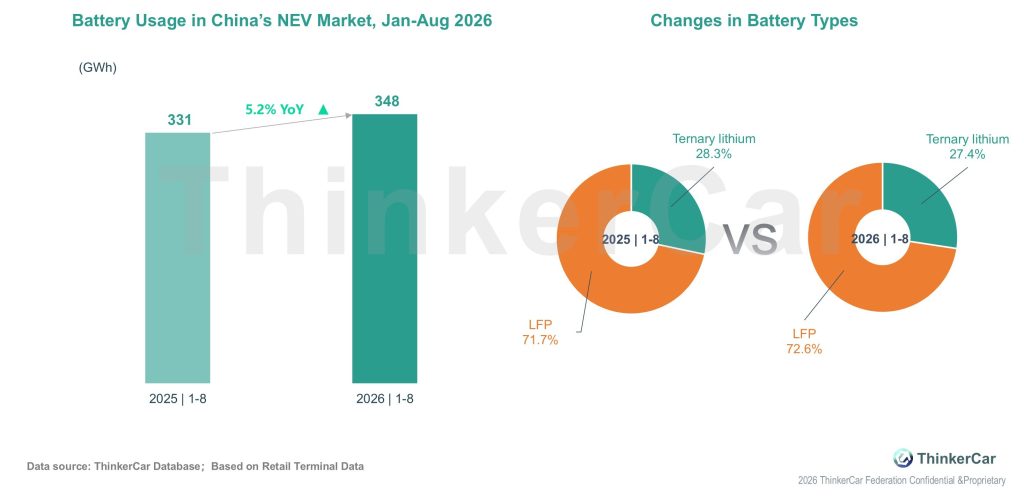
In Jan-Aug 2026, battery usage in China’s new-energy passenger vehicle market reached 348 GWh, rising 5.2% year-on-year from 331 GWh in the same period of 2025. The battery type mix continued to shift: LFP’s share edged up from 71.7% to 72.6%, while Ternary lithium’s proportion declined from 28.3% to 27.4%. LFP remained the dominant battery chemistry for China’s new-energy passenger vehicles, supported by its cost advantages
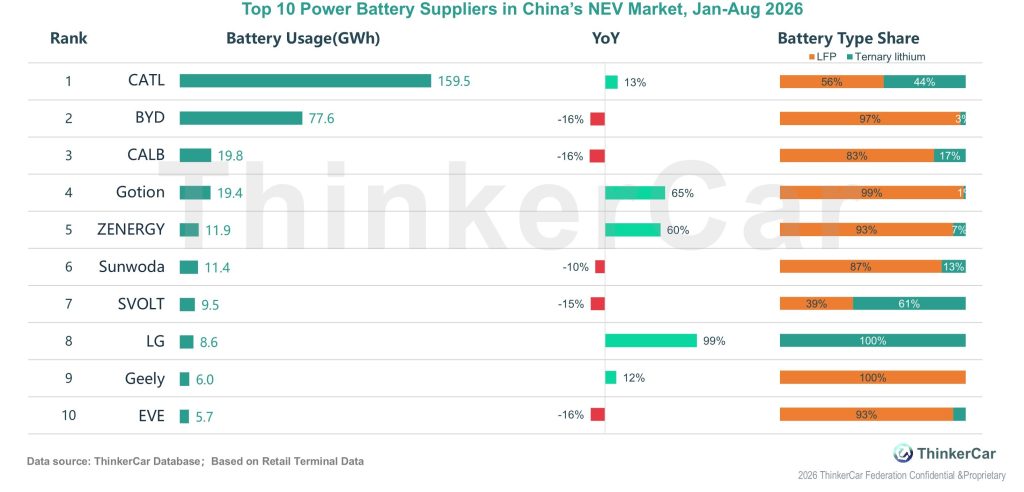
In Jan‑Aug 2026, CATL and BYD remained the top two power battery suppliers in China’s new‑energy passenger vehicle market. CATL ranked first with battery usage of 159.5 GWh, representing a 13% year‑on‑year increase, while BYD took second place at 77.6 GWh, down 16% YoY. Gotion and ZENERGY recorded strong YoY growth of 65% and 60% respectively. Most leading suppliers prioritized LFP products, with SVOLT and LG as the main exceptions; both mainly supplied Ternary lithium batteries.
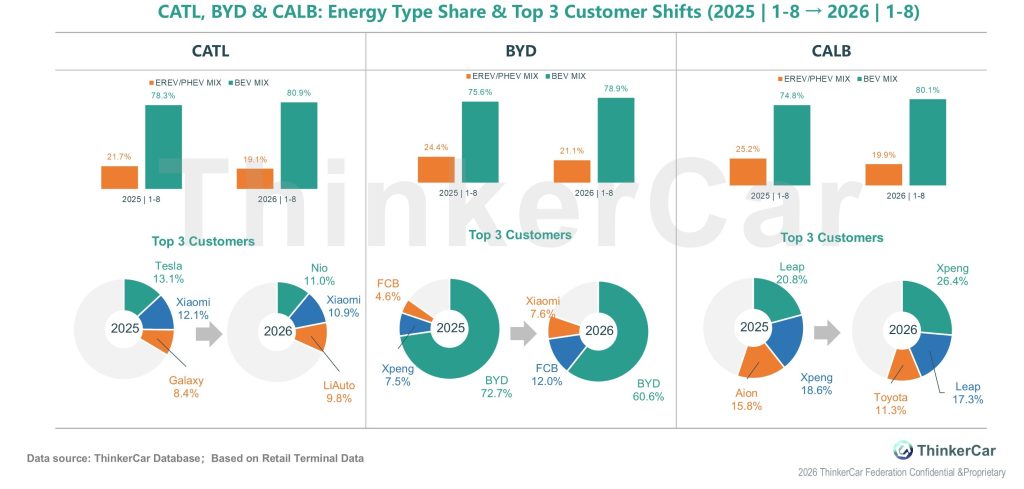
Driven by rising BEV penetration, the top three major battery suppliers lifted their BEV mix. CATL’s BEV mix climbed from 78.3% to 80.9%; Tesla dropped out of its top-three customer list and was replaced by Li Auto. Xiaomi remained among the top clients, while Nio newly joined the top three. BYD still mainly supplied batteries for its self-owned vehicles, with Xiaomi also among its key customers. CALB’s top three major customers changed to Xpeng, Leapmotor and Toyota.
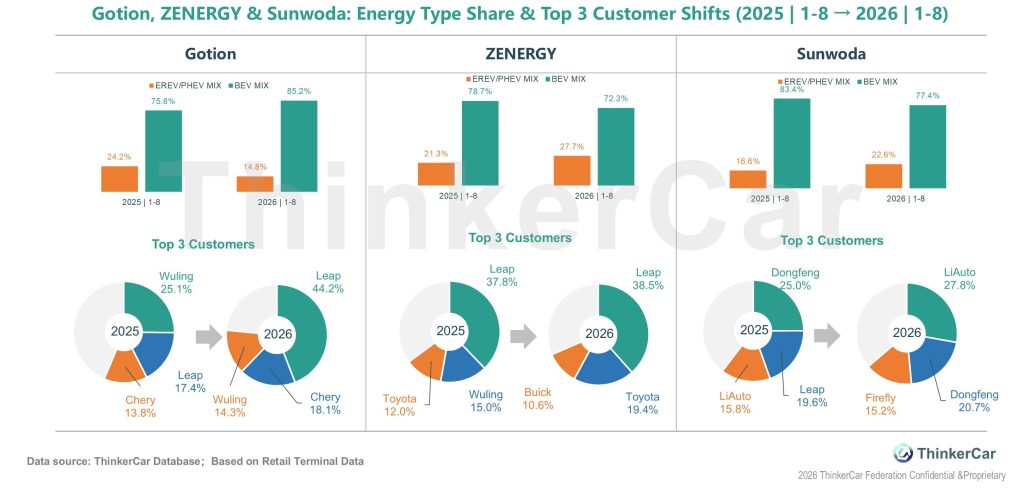
The 3rd to 6th ranked battery suppliers showed divergent BEV mix trends and adjusted their core customer base. Gotion’s BEV mix jumped from 75.8% to 85.2%; Leapmotor became its largest customer, Wuling dropped out of the top 3, while Chery stayed on the list. ZENERGY’s BEV mix declined from 78.7% to 72.3%. Leapmotor remained its top client, Toyota stayed, and Buick newly joined the top three. Sunwoda’s BEV mix fell from 83.4% to 77.4%; Its top three customers shifted from Dongfeng, Leapmotor and Li Auto to Li Auto, Dongfeng and Firefly
ThinkerCar Data
chosen by over 200 renowned global enterprises