
Against the backdrop of rising ADAS penetration in the NEV market, HUD adoption has grown overall, though trends vary by energy type. In 2025, sales of HUD-equipped NEVs rose from ~2.6M units in 2024 to ~3.5M units, with the overall equipment rate climbing from 24.3% to 28.3%. BEVs and PHEVs saw notable increases: BEVs’ rate rose from 15.3% to 21.1%, while PHEVs’ jumped from 19.6% to 28.9%. In contrast, EREVs saw a decline, with their HUD equipment rate falling from 83.9% in 2024 to 72.9% in 2025, even as they remained the segment with the highest adoption
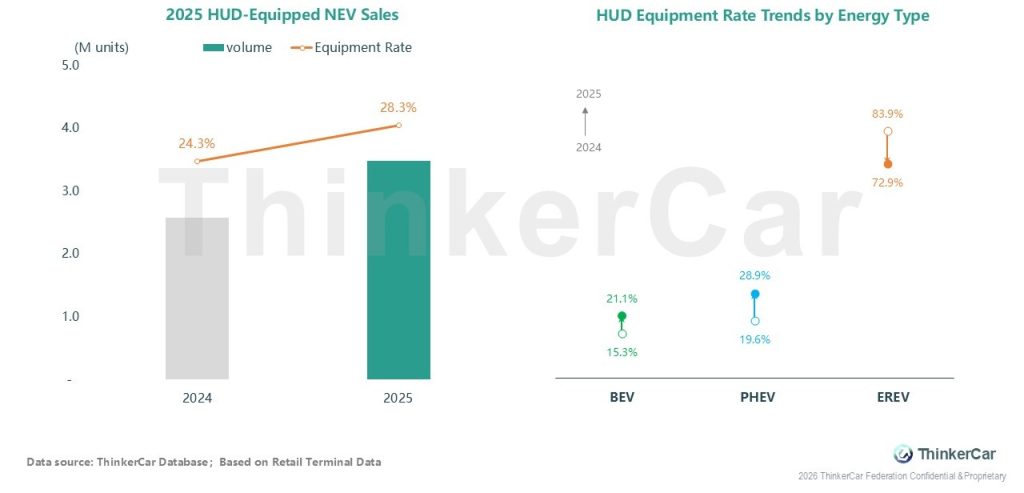
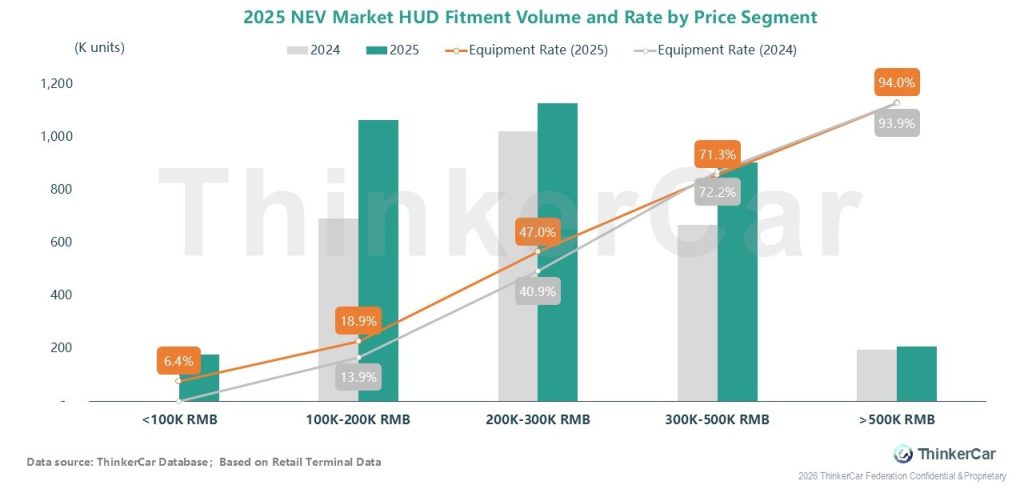
From a price segment perspective, HUD equipment rates in 2025 NEVs varied dramatically by price segment, ranging from a modest 6.4% for vehicles under 100K RMB to near-universal adoption at 94.0% for premium models above 500K RMB. Mid-range segments saw strong growth: 100K–200K RMB rose from 13.9% to 18.9%, and 200K–300K RMB from 40.9% to 47.0%. Notably, the 300K–500K RMB segment saw a slight rate dip (72.2% to 71.3%) with growing volume, while >500K RMB models maintained near-full adoption, cementing HUD as a key premium feature
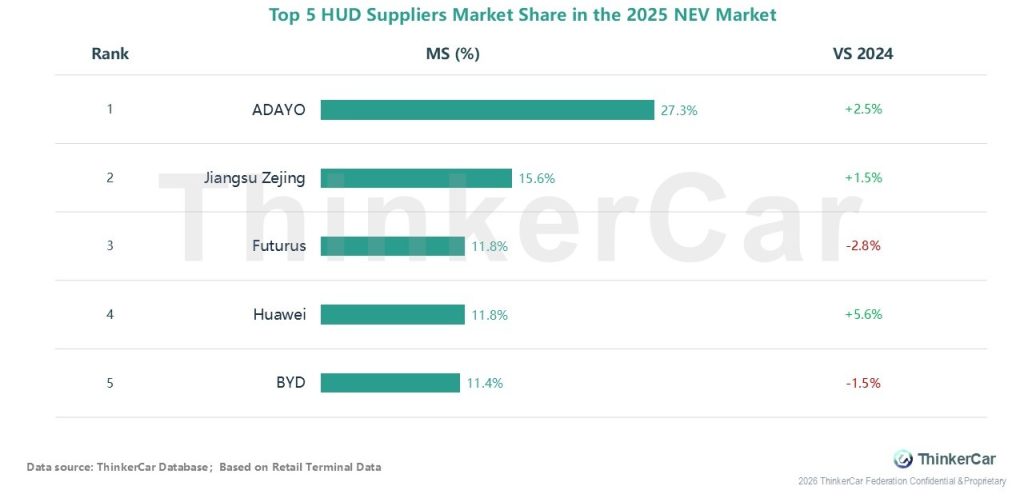
Amid HUD’s rise as a premium NEV cockpit feature, the 2025 supplier landscape is dominated by domestic players with shifting shares. ADAYO leads at 27.3% (+2.5 pct YoY), followed by Jiangsu Zejing at 15.6% (+1.5 pct). Huawei posts the strongest growth, surging 5.6 pct to 11.8%, tying Futurus for third place(11.8%, -2.8 pct), while BYD rounds out the top five at 11.4% (-1.5 pct). This underscores domestic leadership and Huawei’s rapid ascent
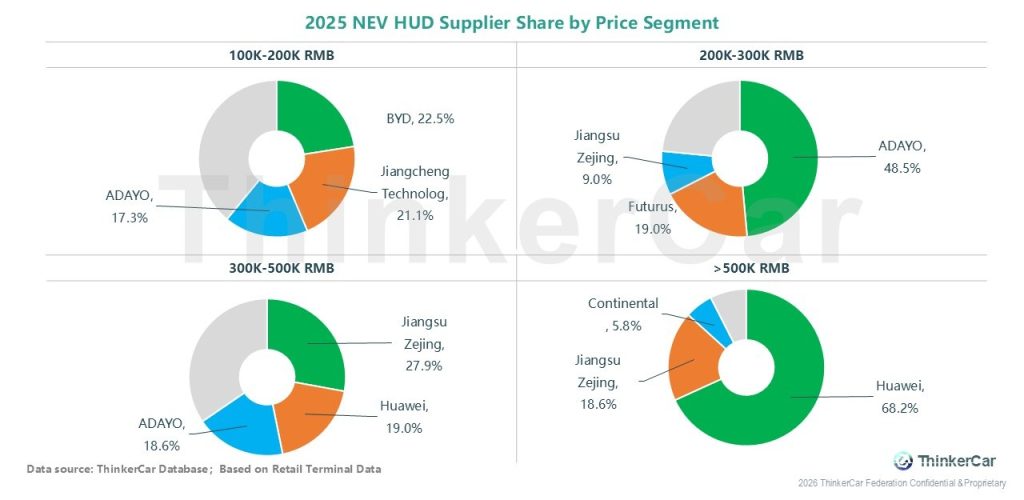
A price-segment breakdown reveals distinct strategies for 2025 NEV HUD suppliers. BYD and Jiangcheng lead the 100K–200K RMB segment, while ADAYO dominates the 200K–300K RMB tier with 48.5% share. The 300K–500K RMB market is competitive, with Zejing, Huawei, and ADAYO in close contention. Most notably, Huawei commands an overwhelming 68.2% share in the >500K RMB premium segment
ThinkerCar Data
chosen by over 200 renowned global enterprises